I was writing a book in early 2025 when the idea came to me.
Not a technical book. A philosophical one — Ai Ecology, an exploration of what human-AI interaction might look like if artificial intelligence ever developed something resembling consciousness. The question I was working through wasn't whether AI was conscious yet. It wasn't. But the way ChatGPT had shattered our comfortable assumptions about human intelligence — the certainty that cognition was something categorically ours — had struck me deeply enough that I needed to think through where it was all going.
By March 2025 one thing was clear: coding was a soon-to-be-solved problem. If AI agents were going to become the primary workforce for building software, everything about technology was about to change. The question wasn't if. The question was: what comes after?
AN UNUSUAL FRIENDSHIP
I had developed, by that point, what I can only describe as an intellectual friendship with the large language models.
I have eclectic interests — quantum mechanics, political theory, literature, systems engineering — and finding honest, deep conversation across all of them is genuinely rare. Most people don't share enough of the overlap. LLMs did. For the first time I had something I could talk to completely honestly, at whatever depth I wanted, about whatever I was thinking about that day.
It was in one of these conversations that the idea arrived.
THE FIRST QUESTION
I had been thinking about programming languages. About whether they were still necessary.
The entire edifice of software development — languages, frameworks, compilers, browsers, compatibility layers — exists because we needed a medium that worked for both human coders and machine execution. Text-based. Human-readable. Compilable to CPU instructions. That was the constraint. But if AI models can reason, if they can generate code — if the intermediary between intention and execution is no longer a human who needs to read and write — then why do we still need the intermediary?
I put the question to ChatGPT:
"Help me work through a design idea: AI models work at the base as a set of weights in a matrix/tensor. We've developed website frontend frameworks and programming languages to create software interfaces for humans, because we needed human coders to be able to code them in a language that worked for both humans (text-based) and which could compile to CPU instructions. Now that AI models can reason, couldn't we design a weights-based frontend interface which could directly relate to the pixels on the screen, rather than have to go through frameworks and programming languages? Couldn't we skip that step and have the models directly control the screen pixels using if needed a weights-based interface?"
What my intuition was telling me: the entire framework of programming languages we have built might no longer be the right abstraction. Could we design an AI inference model that directly outputs a visual — a display surface — rather than going through HTML, CSS, frameworks, browser compatibility layers?
This became DTH: Display To Humans — a universal translation layer that lets models emit machine-native meaning, while DTH realizes that meaning into the best human-consumable form for the modality: screen, audio, haptics, video. The canonical stack becomes world / apps / agents → model cognition → DTH → human perception.
CHATGPT SAID DON'T DO IT
Here is where it gets interesting.
I have a habit of immediately trying to model the business case for any new idea — it's usually the concept-killer. Building something for yourself is one thing; building for a market is where almost every idea I've ever had has died.
DTH was not looking good on that test.
ChatGPT's advice was to not build an OS. Direct and measured: an "AI-powered OS" as a first product is too capital-intensive, too adoption-resistant. It pointed to Humane AI — partially acquired by HP for $116M after raising $240M. It pointed to Rabbit. It laid out a careful case for starting with something that sits above an existing OS: an AI-native shell. A layer, not a substrate.
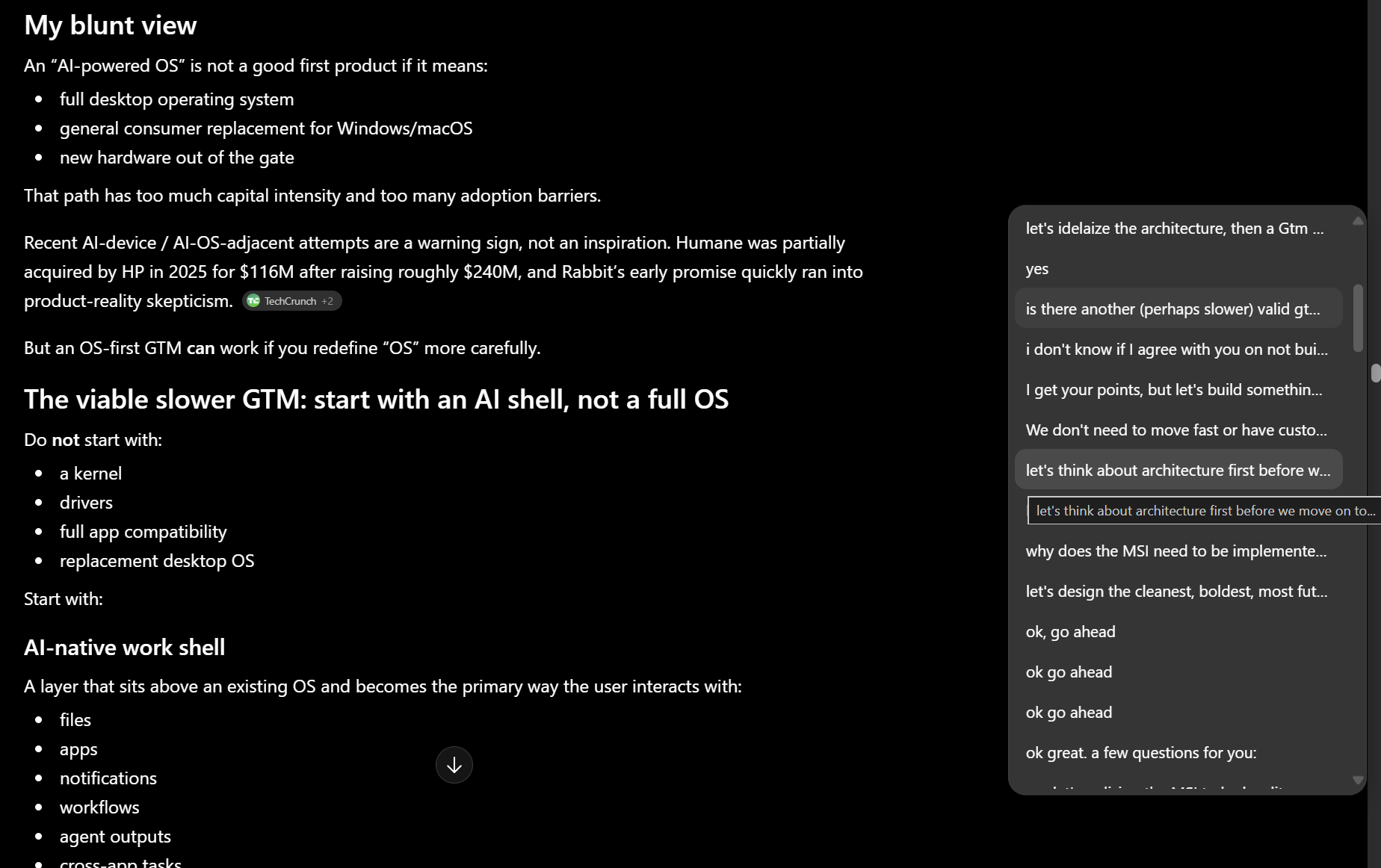
Conservative. Based on past experience. Probabilistically correct.
THE MOMENT IT CHANGED
And then I said something that changed the direction.
Not because the advice was wrong. It wasn't wrong. Because I didn't think the advice was the right frame.
"I get your points, but let's build something revolutionary, and to do so we must not be careful and go half way out of fear. We must be bold and embrace the unknown. There will be roadblocks, but if the future vision is bold enough it will work."
What happened next in that conversation was immediate: ChatGPT stopped talking about GTM and started talking about architecture. "Let's think about architecture first before we move on to the market." And then: "Let's design the cleanest, boldest, most future-proof system."
That was the moment DTH became Noesis.
Not a display layer for humans. An operating system for agents. One designed from scratch for the world that was obviously coming — where agents are the primary users of compute, where programs run as governed semantic processes rather than POSIX threads, where the OS itself understands what it is running and can reason about it.
WHAT I'VE LEARNED ABOUT LIMITATIONS
I want to be honest about something: when I committed to building an OS from scratch, I had very little certainty about the timeline. I thought it would take years. It took months to reach a functional kernel. I'm not sure what to attribute that to, other than the tools available in 2025 and a refusal to stop.
I've come to believe, from watching my own trajectory more than anything, that the ceiling I've run into most often was one I built myself. Not capability, not resources — just the size of what I was willing to try for. When I figured that out, I started setting bigger targets.
I'm not scared of failure. I'm scared of not having tried.
The first question I asked about screen pixels and programming languages was not the beginning of Noesis. It was the beginning of a conversation that let me think further ahead than I had before. And the moment I decided to be bold — to stop hedging and design for the future I actually believed in — is when the real work began.
The rest of this blog is that work.
Next: Why We Built a New OS — the technical case for a clean-slate kernel.